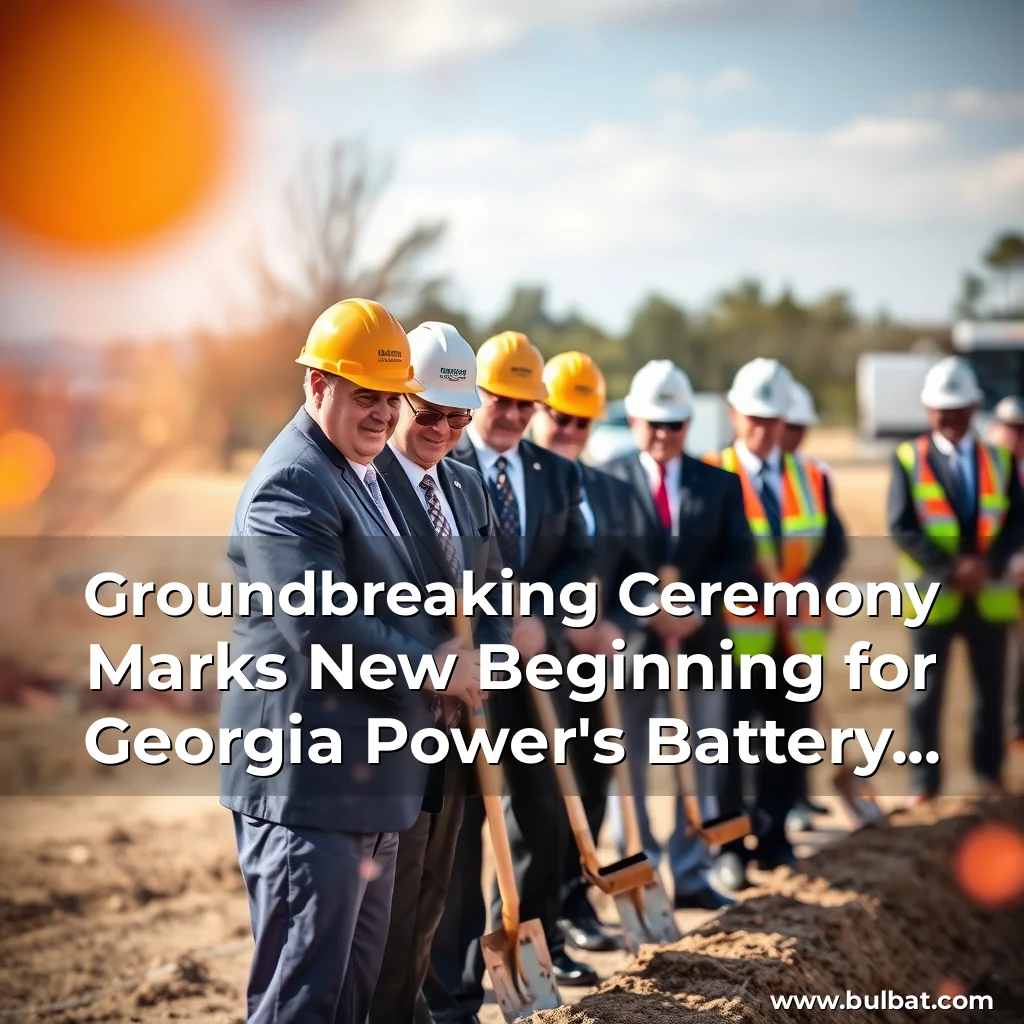
Georgia Power is taking a significant step forward in its efforts to transition towards a cleaner, more sustainable energy future with the groundbreaking ceremony for its new battery complex, the Hammond Battery Facility. Located on the grounds of the former Plant Hammond coal plant in Coosa, the complex is set to become a game-changer in the utility’s approach to power generation and energy storage.
The event was attended by various dignitaries, including Melissa Free, Georgia Power Regional Executive, who spoke about the significance of the site. Free’s family has a personal connection to the area, having moved to Rome in the 1980s when her grandfather helped build a cooling tower at Plant Hammond. “So if not for this place, my family may not have been Romans,” Free said. “A fate I simply cannot imagine.”
Georgia Power’s battery system is expected to store approximately four hours of power during times of low demand, which will then be drawn upon during times of peak usage. This is a significant step forward for the company, as it marks the first time it has re-purposed an existing coal plant for use as a battery storage facility. “By repurposing the existing generation site at the former Plant Hammond, we are providing significant benefits to customers,” said Kim Greene, Georgia Power Chairman, President and CEO. “The system will be able to store over 57 megawatts of power and release it over a four-hour period, which is enough to power 50,000 homes.”
The project is part of a larger plan approved by state energy regulators last April, which includes other forms of renewable energy and fossil fuels. The battery technology is expected to play a crucial role in providing energy during peak periods, whether hot or cold. “The battery technology is wonderful because it allows us to provide energy during peak periods, whether hot or cold,” Greene said. “And we can then charge these batteries when demand is low and we have excess energy.”
Rome Mayor Craig McDaniel attended the ceremony, sharing his own personal experience working at Plant Hammond. McDaniel began his first job after graduating from high school, working at the plant where he was tasked with sweeping coal dust. However, after only two weeks, he moved on to a better-paying job at the Georgia Pacific plant next door. “A man named Duke Hicks handed me a broom, and we swept coal dust every day,” McDaniel said. “I asked Duke if all we were gonna do is sweep dust every day? He said no, next week will be different.”
“So we stopped sweeping and started shoveling,” McDaniel said. After his public remarks were over, McDaniel shared that he only lasted two weeks at Plant Hammond before moving on to a better opportunity. “Georgia Pacific paid over three dollars an hour, and you could get as much overtime as you wanted,” McDaniel said. “I put myself through college working there.”
Floyd County Commission Chair Allison Watters also attended the ceremony, expressing her gratitude to Georgia Pacific for repurposing the plant. However, she also acknowledged the county’s loss of revenue from the closure of Plant Hammond. “The closing of Plant Hammond still stings a bit,” Watters said. “But what a great opportunity to repurpose this property. We look forward to working with Georgia Power, which has been a huge partner of ours for many years.”
_Highlights:_
- Georgia Power’s battery complex, the Hammond Battery Facility, will consist of a 57.5 megawatt large battery energy storage system.
- The system will store approximately four hours of power during times of low demand.
- The battery technology will provide energy during peak periods, whether hot or cold.
_Key Statistics:_
| Capacity | 57.5 megawatts |
| Power equivalent | 50,000 homes |
| Purpose | Store power during low demand, release during peak usage |
_Definitions:_
A cleaner, more sustainable energy future is within reach as Georgia Power continues to push forward with its innovative projects like the Hammond Battery Facility.