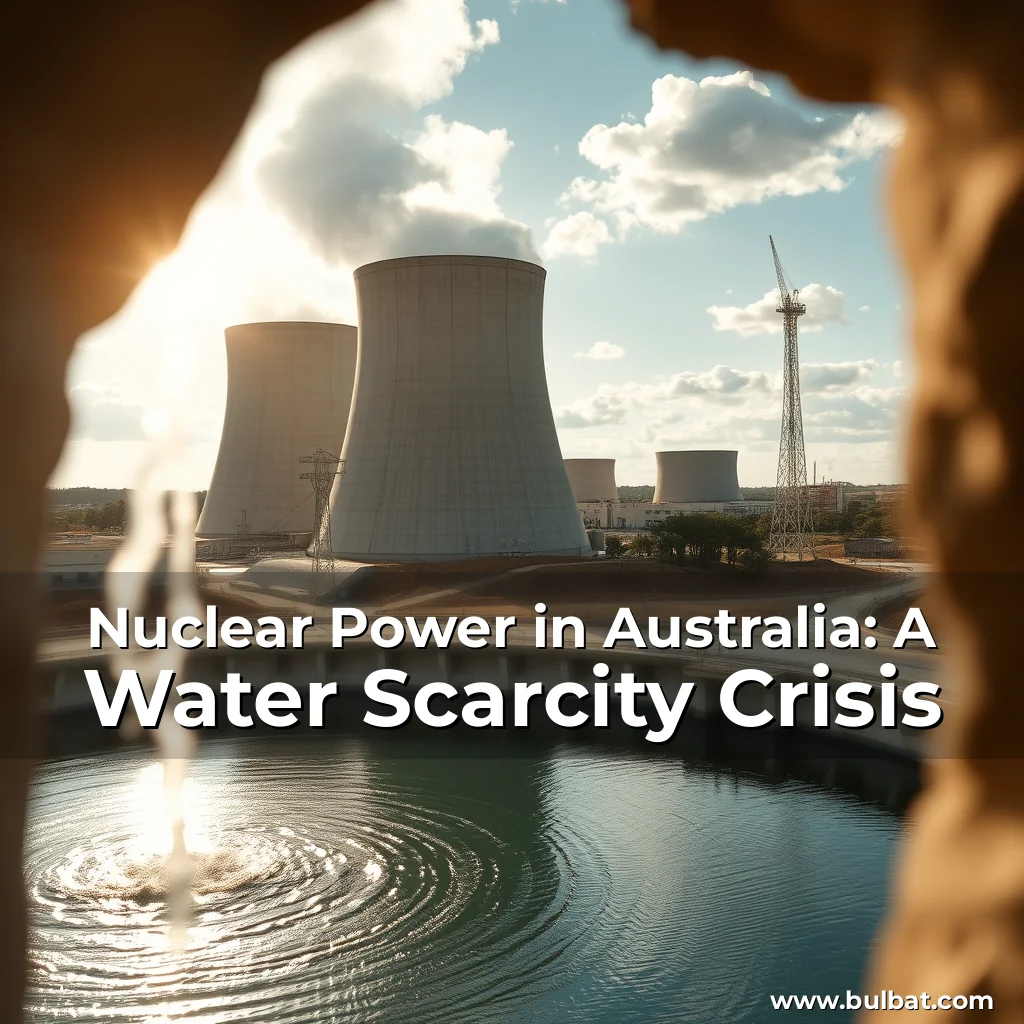
Water Requirements for Nuclear Power Plants
- Nuclear power plants in Australia would require an additional 200 gigalitres of water to operate at full capacity
- Only one of the seven proposed nuclear power stations could access enough water to meet this requirement
- The plant proposed for Port Augusta in South Australia was the only facility near a coastline, which would be advantageous for water supply
The report by Liberals Against Nuclear highlights the significant water scarcity issue facing Australia’s proposed nuclear power plants. According to the report, a single facility could access enough water to operate at full capacity, while the remaining six plants would face substantial challenges in securing the necessary water supply. This has significant implications for the potential development of nuclear power plants in Australia. The proposed nuclear power plants were expected to produce more than 13GW of electricity and operate at 90% capacity, as modeled by Frontier Economics. However, the new study found that only one facility, located in Port Augusta, South Australia, could access enough water to meet this requirement. The remaining six plants, located in Victoria, New South Wales, and Western Australia, would require significant additional water to operate. The challenges facing the remaining six plants are significant. Nuclear reactors planned for Loy Yang in Victoria would require around 7.5 gigalitres of water, while those planned for Mt Piper in New South Wales would require around 100 gigalitres. Plants proposed for Muja in Western Australia would require a significant amount of water, ranging from 50 to 125 gigalitres, depending on the specific plant. The plants proposed for Liddell in New South Wales and Callide in Queensland may need additional water in the future, while Tarong in Queensland could function with existing resources but at a lower capacity. The report’s findings highlight the need for a thorough examination of the water requirements for nuclear power plants in Australia. The Australian National University visiting fellow, Professor Andrew Campbell, emphasized the importance of considering water consumption as part of the public debate around nuclear energy. “You’re either taking water away from irrigators or you’re taking it away from other industrial users or you’re taking it away from towns to try to keep your nuclear power station running,” he said. Professor Campbell’s comments underscore the need for a more nuanced approach to nuclear energy in Australia. The challenges facing the remaining six plants are significant, and the potential impacts on water supplies, industry, and local communities must be carefully considered. The report’s findings also raise questions about the feasibility of developing nuclear power plants in Australia, given the potential water scarcity crisis.
The Coalition’s Response
The coalition has pledged to develop nuclear power plants in five states if it wins government. Opposition Leader Peter Dutton was asked about a potential backflip on the party’s nuclear proposal, but he stated that he would “certainly not” relent on the policy. “We’ll have reliable power, cheaper power,” Mr. Dutton said. “I’m very proud of the energy policy we’ve got.”
Mr. Dutton’s comments highlight the significant differences between the coalition’s approach and the concerns raised by the report. The coalition’s energy policy, which includes a national gas plan, aims to reduce energy costs and increase reliability. However, the report’s findings suggest that the potential impacts of nuclear power on water supplies and industry must be carefully considered.
Alternative Energy Solutions
Separate research released by Renew Australia for All found that solar and battery storage solutions would be significantly cheaper for households than nuclear energy. The report found that the average household would pay an extra $665 per year on current bills with nuclear power stations added to the grid compared to a $1727 annual saving on today’s bills if all homes had solar and batteries installed. This finding highlights the potential benefits of alternative energy solutions for households. Solar and battery storage solutions could provide a more affordable and sustainable option for households, reducing the need for nuclear energy. The report’s findings also underscore the need for a more nuanced approach to energy policy in Australia, one that considers the potential impacts of different energy sources on households and the environment.
Conclusion
The water scarcity crisis facing Australia’s proposed nuclear power plants is a significant challenge that must be carefully considered. The report’s findings highlight the need for a more nuanced approach to nuclear energy in Australia, one that takes into account the potential impacts on water supplies, industry, and local communities. While the coalition’s energy policy aims to reduce energy costs and increase reliability, the report’s findings suggest that the potential impacts of nuclear power on water supplies and industry must be carefully considered. Alternative energy solutions, such as solar and battery storage, may provide a more affordable and sustainable option for households. Ultimately, a more nuanced approach to energy policy is needed to ensure that Australia’s energy needs are met in a sustainable and responsible manner.

news is a contributor at BulBat. We are committed to providing well-researched, accurate, and valuable content to our readers.