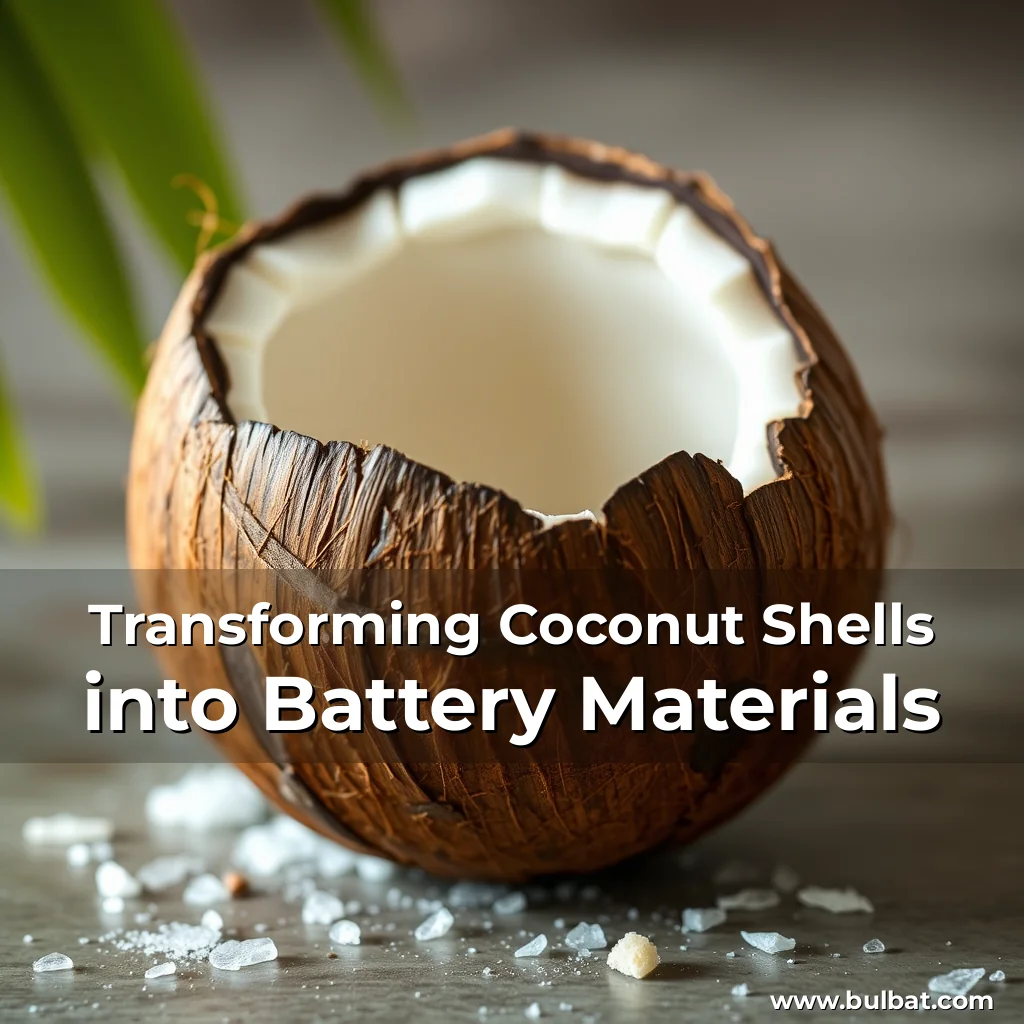
The Surprising Truth Behind Coconut Shells
Coconut shells are often discarded as agricultural waste. However, their fate takes a dramatic turn when they’re transformed into a crucial component of a sodium-ion battery—the hard carbon anode. This remarkable process involves several steps, which we’ll delve into below.
Step 1: The Acid-Base Bath
When coconut shells are first obtained, their surfaces are covered with impurities such as dust and metal ions. The first step is to “bathe” them in hot alkaline water (sodium hydroxide solution) and boil to remove ash and grease; followed by soaking them in acidic water (hydrochloric acid solution) to remove residual metal ions; and finally, drying them to turn into clean coconut shell powder, as fine as ground coffee beans.
- • Removing ash and grease from the surface of the coconut shells.
- • Purifying the coconut shells by removing residual metal ions.
- • Drying the coconut shells to obtain clean coconut shell powder.
Step 2: Creating Small Holes with Potassium Hydroxide
The coconut shell powder naturally has some pores, but not enough. To create more pores, a “hole-punching expert”—potassium hydroxide (KOH)—is needed. Mixing the coconut shell powder with potassium hydroxide in a certain ratio and heating it in a high-temperature furnace to 800℃ can create a large number of small holes on the surface of the coconut shell carbon.
| Process | Description |
|---|---|
| Step 2 | Mixing coconut shell powder with potassium hydroxide and heating it to 800℃ to create small holes. |
Step 3: Shaping into Hard Carbon
The coconut shell carbon, just after being perforated, is not yet sturdy enough and requires further “training”: it is placed into a furnace at a higher temperature (from 1200 to 1400℃) and baked for several hours, similar to steel smelting. At high temperatures, the carbon structure becomes more stable, forming a “hard” skeleton, which is hard carbon.
Step 4: Dressing Hard Carbon with a Protective Coat
To ensure better compatibility between hard carbon and the electrolyte, it undergoes a “beauty treatment”: the hard carbon powder is bathed in a citric acid solution and then heated and dried. This process forms a thin “protective coat” on the surface of the hard carbon, reducing side reactions during battery charging and discharging, thereby making the battery more durable.
Step 5: Testing the Battery’s Performance
The processed hard carbon is mixed with a conductive agent and adhesive to form a slurry, which is then coated onto copper foil and dried, resulting in a battery anode. Tests show that it can store 0.28 milliampere-hours per gram of electricity and retain 92% of its capacity after 200 charge-discharge cycles.
Step 6: Future Prospects
Coconut shells, originally agricultural waste, have now become battery materials, which are both environmentally friendly and cost-effective. Currently, scientists are exploring ways to enhance their capabilities, such as pairing them with graphene to improve performance or using cheaper electrolytes. Perhaps in the near future, your home’s ESS battery or EV will contain “green energy” derived from coconut shells!

news is a contributor at BulBat. We are committed to providing well-researched, accurate, and valuable content to our readers.